Beginner Running Tips: 10 Rules That Actually Matter
Start slower than feels necessary. Build up gradually. And use a run/walk structure rather than trying to run non-stop from day one — that's the single most important thing to know before you read another word. The ten tips below all flow from that one principle.Tip 1: It's Never Too Late (and You Don't Need to Be "Fit" First)

Check the age groups in the results of any local race. The majority of the field is 35 and older. It's never too late to start running. That excuse is just one of several common beginner jogging myths, debunked.
Tip 2: See a Physician First If Any of These Apply

Hey, better safe than sorry.
Tip 3: Warm Up Right, and Don't Stretch Cold Muscles

Here's the thing: stretching cold muscles doesn't help, and it can actively hurt. You risk a muscle pull or a strain before you've even started running properly.
Save your stretching for after the run, as part of your cool-down. For the specifics on which stretches to do and when, see my running stretches page.
Tip 4: Start With a Run/Walk Program

Either way, be the tortoise, not the hare.
Tip 5: Run at a Pace You Could Talk At

I see this constantly on Strava — sedentary beginners regularly clock faster paces than my own easy runs, and I'm the one who has to tell them to slow down. It's a pattern I see again and again with the runners I coach.
Ignore this rule and you'll burn out early in the workout, and you'll end up cutting your run short. Slow down, and you'll get more out of every session.
Tip 6: Build Time Before Speed, and Mileage by No More Than ~10% a Week

Here's a worked example: if you're running 10 minutes a day this week, aim for 12 to 15 minutes next week, then 15 to 18 the week after. Build up the time you spend running slowly but surely.

Tip 7: Run at Least 3 Times a Week, Not Fewer

Running once or twice a week makes progress much harder, though not impossible. And each running day should be followed by a rest day, so your body can adapt.
Tip 8: Add Strength Training
Strength training isn't optional once running becomes a regular habit. An overall routine that targets your core, hips, glutes and legs — think squats, lunges, push-ups and planks — pays off in two ways.It helps you maintain good form as you get tired, and it reduces your risk of injury. For a lot more detail, see my strength training for runners page.
Tip 9: Check Your Pulse and Keep a Running Log

Check your rest heart rate first thing in the morning, before you get out of bed — count your pulse for 10 seconds and multiply by six. If it's 5 to 8 beats per minute higher than yesterday, take a rest day instead of a hard run.
In your log, note distance, time and workout type as a minimum. Add your weight, pulse, or how you felt if you want to go further — over time, the pattern tells you far more than any single run.
Tip 10: Listen to Your Body (and Rest Before It's Forced On You)

The problem is almost always the same: we try to run through the pain. We're mid-programme, or building for a race, and we push on instead of backing off. I tell my athletes not to run through pain, and I'll tell you the same thing.
A day or two off usually resolves early-stage pain. Don't push through it for the sake of a race or a schedule. And build in at least one rest or recovery day a week as your baseline — not just as a reaction once something already hurts.
If a niggle or a break has already derailed your streak, here's how to get back on track after a broken running streak.
Frequently Asked Questions
What's the single most important tip for a new runner?Build up your mileage safely and slowly, and invest in properly fitted running shoes and socks early — the two biggest, most avoidable causes of injury and blisters.
How do I fit running into a busy schedule?
It comes down to a handful of practical scheduling habits — see fitting running into a busy schedule for the full breakdown.
What's a realistic first-month goal for a new runner?
Aim for consistency — running three times a week for four straight weeks — rather than chasing a distance or a pace target. See what a full first month looks like for the complete plan.
I'm completely new — where do I even start?
Start with safety and logistics before your first run, then move into one of my Beginners Running Programs once you're cleared to begin.
What should I do once I can comfortably run 5K?
Build towards a 10K in relative ease before you even think about a half marathon. Don't rush straight to a marathon from a 5K base.
More Pages on This Topic
Some Other Pages You May Like
About the author

Dominique de Rooij (Dom)
Advanced Running Coach certified by Athletics Australia with 20 years of writing about running and over a decade coaching runners — from first-timers to marathoners. Dom's beginner programs have guided thousands of runners and been praised above plans from Jeff Galloway, Hal Higdon, and Runner's World. Now over 50, Dom still loves trail running, parkrun, and the coffee after.
Free beginner guide • From Coach Dom
Start Running This Week, Even If Your Week Is Already Full
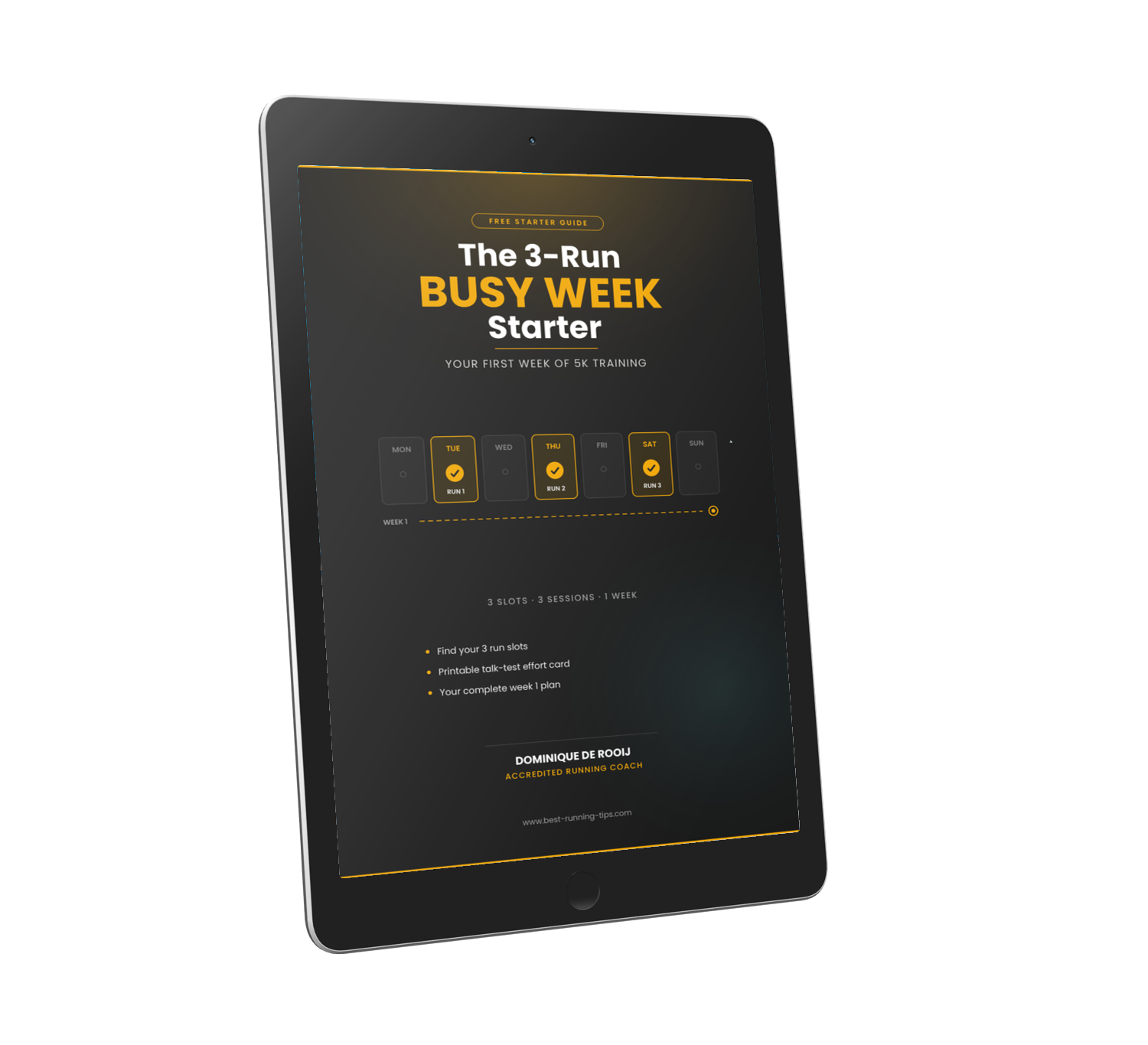
Most beginners don't quit for lack of motivation. They quit because their plan doesn't fit their life. The 3-Run Busy Week Starter plans your first week around the week you actually have.
- Find 3 run slots you can actually keep
- The talk test: the simple way to stop running too fast
- Your complete week 1 plan: 3 run/walk sessions, about 20 minutes each
You'll get the guide plus a short email every few days to help you through week 1. Unsubscribe any time. Privacy policy.
What's New?
-
Personalized Running Coaching - BRT | Run Smarter, Race Better
 Get a personalized running program built around your current fitness, goals, and schedule - not a generic app template. Choose from BRT Silver, Gold, or Platinum coaching with Dom, accredited running…
 -
Sample 4-Day Marathon Training Week: Base to Taper
A full 4-day-a-week marathon training schedule, phase by phase - base, build, peak, and taper - with named workouts and weekly mileage. -
Marathon Taper for a 10-12 Week Training Cycle
How to taper correctly on a compressed 10-12 week marathon plan - the right taper length, why standard advice doesn't fit, and the week-by-week structure.
