Goal Pace: How to Calculate and Run It
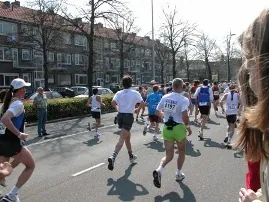
I've watched too many runners nail their training only to blow up spectacularly on race day. You know the story — you start too fast, convince yourself you're having a magical day, then pay for it dearly in the second half.
That's where goal pace training saves you. It's not just about knowing your target time — it's about making that pace feel natural, automatic, sustainable.
What Is Goal Pace and Why It Matters for Race Training
I always get nervous before races. Doesn't matter if it's a 5K or marathon — I'm hitting the bathroom, stretching obsessively, checking my watch. But once the gun goes off, that anxiety vanishes because I know exactly how fast to go. Why? Because I've rehearsed that pace hundreds of times in training.
Race day brings out something extra in you, but it also brings distractions. The crowd, the excitement, other runners — everything conspires to mess with your pacing. When you've drilled your goal pace into muscle memory, you can trust your feel even when your GPS watch is acting up or you're caught in a pack running slightly off pace.
The magic happens when goal pace stops feeling like work and starts feeling like home. That's when you know you're ready to race.
How to Calculate Your Goal Pace for Different Race Distances
How to Train at Goal Pace Without Overtraining

Goal pace sessions can be very tough. So limit them to once a week. And do them in the last 1-2 months before your goal race, not year round.
Also, start with shorter segments early in your build-up. For 5K training, you could start with 12 x 400m at goal pace with generous recovery. For marathon training, you could start with just 15 minutes at goal pace within your long run.
Build gradually. Add volume to your goal pace segments before you add frequency. Especially for longer distances. When training for a marathon, I'd rather see you run 6 miles at goal pace once per week than 3 miles twice per week. Note, that 6 miles can still be 2 x 3 miles within the same session with a jogging break in between. But there is value in doing more goal pace within the single session. It frees up other sessions in the week for sessions at adjacent speed, e.g. half marathon pace / tempo runs.
Time your goal pace sessions carefully in the week. These should count as a hard sessions. So, never do them when you're too deeply fatigued from other training. You want to practice good pacing habits, not survival running. Schedule them after an easy day, and follow them with recovery.
Recovery between repetitions should be just enough to maintain pace quality. For shorter, faster intervals (400m-1K), that's usually 60-120 seconds. For longer, slower segments (3-6 miles), take 2-3 minutes between efforts.
Goal Pace Workouts: Specific Session Types with Example Plans
Different race distances demand different goal pace approaches. Here are the sessions I use most often, tested over years of coaching runners to breakthrough performances.5K Goal Pace Running

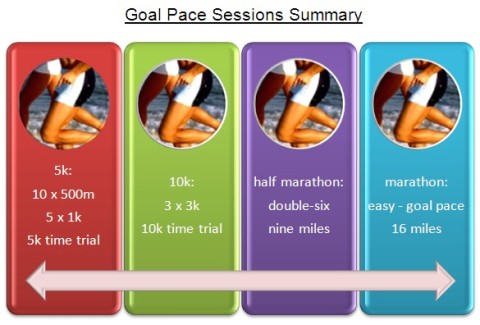
Ten 500-metre repeats
For me, this one is a powerful indicator. But, as I said before, you have got to find out for yourself if this works for you. Run 500 metre-repeats at goal speed. Walk or jog for 45 seconds in between. Repeat ten times. You can run all repeats at goal pace? Then you are probably ready for your 5K!Five 1k Repeats
Same idea as before, but better: do five 1k-repeats with a short break in between (e.g. 45 sec - 90 sec). Able to do it?Then your 5k goal is definitely possible!
Why better? The longer that goal pace interval becomes, the tougher the challenge to keep the pace. Running 5 x 1k is much harder than 10 x 500m at goal pace.
5K Time Trial or Test Race
The 5K is a short enough distance to run the complete distance in training at goal pace.Just do a 5K as fast as you can in training.
See if you reach your goal or get close to it.
This type of training, a time trial, is tough though.
You don't have others around you to help you keep your speed.
And it's easy to give in to the tiredness without the stimulation of a real race.
That's why you might be better off putting test races in your running schedule.
If you are in the middle of a tough training program your legs will be fatigued at test-race day. You will most probably not be able to maintain your goal pace the whole race.
But just go out at your goal pace and see how long you can maintain it. No worries if you crash and burn. This is your test race!
If you already feel like you can't go anymore after 1 mile, then you might be a long way from your goal. But if it happens in the last mile before the finish, then there is a good chance that with a bit more quality training, a good taper and fresh legs you'll be able to finish your key-5K at the desired speed.
10K Goal Pace Running Workouts
Three 3K-repeats
 This is a toughie, especially in loaded training weeks. But when you can do this one, you are close to being able to run your 10K in your desired time. So do three 3K-repeats with a 1.5 minute jog in between. After this training, put in a few easy days.
Also, please do not leave your goal speed sessions to the last week before your goal race. Try to to do them three to five times in the four to six weeks leading up to a key race to get a feel for the pace.
Alternative goal pace workouts that you could use in the lead-up to 3 x 3k are 8 x 1k and 4-5 x 2k.
10K Time Trial or Test Race
As with a 5K time trial, it might be easier for you to schedule in test races. See what works best for you.A time trial is a bit more convenient to find time for. You can do it any time, any day. But it is a hell of a lot tougher to keep your pace when there is nobody around you. It is definitely not something I do.
I can do a 5k time trial on my own and race my heart out. It is short enough to keep the pace. But a 10k is too long for me.
To just run at this uncomfortably hard pace for 40 minutes or so, is very tricky in non-race conditions.
Half Marathon Goal Pace Running
Double-Six
Time to introduce some of my own lingo. This one I call the Double-Six.First run six miles at an easy pace.
Then run six miles at goal speed.
Why do six easy miles first?
Well, you see, the trick is that when you start doing your goal pace miles when your legs are already a bit tired.
If you can maintain the pace for mile 7-12 with already tired legs, then you can feel pretty confident about making it to your goal.
One prolonged effort
Run nine miles at your half marathon race pace. Nine miles is a little less than 70 % of half marathon race distance (=13.1 miles / 21.1 K).Able to run 70 % of race distance at goal speed? Then, with your extra "race day powers", you should have a good chance of being able to run the full race at goal pace.
A third option for the half that has worked for me in the past, although it is not technically goal pace running, is to see if you can run 12 miles at goal pace + 15 sec/mile (goal pace + 10 sec / km). Able to do that? Then you are probably good to go for your half marathon goal time!
Half Marathon Pace Intervals
If one prolonged race pace effort sounds too hard or too mentally challenging, break it up into intervals, e.g. 5 x 3k at half marathon pace with 1k jogging in between is a very solid session.Marathon Goal Pace Running Workouts
 The longer your race gets, the more important it is that you go out at race pace. Not faster.
It is often said, that for every minute you gain in the first miles of the marathon, you lose five minutes in the last miles.
In a 5k you can chance things a bit more. You can go out aggressively, then hang on for dear life, maybe slow down (and die a little bit) during the last mile... In other words, let Jesus take the wheel... But knowing what you can and cannot do is of utmost importance when running the marathon.
And, maybe even more than with other distances, goal pace running, is an incredibly vital component of marathon training when you are intending to really race the marathon. Think about it. You will have to ready yourself for 26 x 1 mile at goal pace or 42 x 1k at goal pace. That's a lot. So, you want to get very familiar with goal pace running and build up the experience with running at goal pace for longer periods of time.
With marathon goal pace running, we have basically three types of goal pace sessions at our disposal:
Easy, Then Goal Pace
For a while we were lured in believing that the LSD = long slow distance run, was the key to marathon success. It is definitely very important. But as important is the long run with a fast finish.So start off slow, but for the last three to eight miles pick up the pace. As with the half marathon workout, key is that you run goal pace miles when your legs are already tired.
One Prolonged Effort
More and more elite-runners are running big parts of their long runs of 20 and 20+ miles at marathon pace. These sessions are extremely taxing and do not belong in the regular running program of us, mortals.But we can learn from the elites and at least try to do some longer runs at marathon pace when preparing for a marathon. Build up these long runs to about 15-16 miles in length. They'll give you a good training at maintaining your pace for a long, long time.
And it is generally believed, that if you are able to run 16 miles at goal pace, you'll be able to run your marathon at goal pace.
Intervals at Marathon Pace
Like with the half marathon, to work up to the one long prolonged effort as described before, you can use intervals to get you ready for them. You could start by making every second mile in your long run at marathon pace, then slowly build up to something like 3 x 4 miles at goal pace in your long runs.How to Adjust Goal Pace When Conditions Change
Race day rarely offers perfect conditions. Learning to adjust your goal pace for heat, hills, wind, and other variables can mean the difference between a breakthrough performance and a struggle-fest.Heat adjustments are critical and often underestimated. For every 10°F above 60°F (16°C), slow your pace by approximately 6-8 seconds per mile. In 80°F (27°C) heat, that's 12-16 seconds per mile slower than your optimal conditions goal pace. This isn't giving up — it's smart racing.
 I learned this the hard way during a marathon in 85°F heat. Stuck to my goal pace for 16 miles, then completely fell apart. The runner who passed me in the final 10K had started 20 seconds per mile slower, then negative-split when others were walking.
Hill adjustments require different strategies for ups and downs. On uphills, maintain your effort level, not your pace. A good rule: lose 15-20 seconds per mile for every 1% gradient increase. On a 3% climb, expect to run 45-60 seconds per mile slower while maintaining the same physiological effort.
On downhills, resist the urge to go much faster than goal pace. Yes, gravity helps, but excessive downhill running destroys your quads for the flat and uphill sections that follow. Aim for 10-15 seconds per mile faster than goal pace on moderate descents. Feel the flow, don't pound the living daylights out of your quads!
Wind adjustments depend on direction and strength. Headwinds of 15+ mph can slow you by 10-15 seconds per mile — and that's with good pacing discipline. The temptation is to fight the wind by running harder, but this burns matches you'll need later. Instead, slightly reduce your pace and tuck behind other runners when possible.
Tailwinds feel amazing but create their own problems. Don't let a strong tailwind early in the race seduce you into banking time. You'll pay for it when you hit crosswinds or headwinds later. Stay disciplined with your effort level, even if the pace feels easy.
Altitude effects kick in above 3,000 feet and become significant above 5,000 feet. Expect to slow by 2-4 seconds per mile per 1,000 feet of elevation gain above 3,000 feet. At 6,000 feet elevation, that's 6-12 seconds per mile slower than sea level goal pace.
For very short races, you can get away with a lot. However the marathon (and to a lesser extent) the half marathon deserve respect. The problem is that we have so much invested in the training and the hope for a particular time, that we do not want to adjust our plans.
But having been in hot races, windy races, races with very mean hills, I have learned plenty about not taking into account the conditions. And keep in mind, I was running before they invented GPS watches! You had to learn what certain paces felt like. GPS watches, Grade Adjusted Pace etc, etc, make it all a lot easier.
Still, the ego is a powerful detractor from achieving the best for what the day has in store for you. So, learn to stay flexible during a race. Your GPS watch might show you're running 10 seconds per mile slower than goal pace, but if you're working at goal effort level in tough conditions, you're executing perfectly. Smart pacing wins races, not blind adherence to numbers.
Some other pages you may like
Home > Running Training > Goal Pace

About the author
Dominique de Rooij (Dom)
Advanced Running Coach certified by Athletics Australia with 20 years of writing about running and over a decade coaching runners — from first-timers to marathoners. Dom's beginner programs have guided thousands of runners and been praised above plans from Jeff Galloway, Hal Higdon, and Runner's World. Now over 50, Dom still loves trail running, parkrun, and the coffee after.
Free weekly coaching • Join 3,500+ runners
Train Smarter, Not Just Harder
Get your free guide when you join the BRT Coaching Letter
No spam, ever. Unsubscribe in one click, any time.
What's New?
-
Base Running: Build Your Aerobic Foundation
 Learn the essential base running foundations every runner needs. Coach Dom explains how to build aerobic fitness safely with step-by-step drills and training tips.
 -
Peaking for a 15k - Expert Running Coach Training Plan
Expert running coach advice on peaking for a 15k race. Complete training plan from base building through race preparation, with specific timing and workout recommendations. -
Sub 40 Minute 10K Training Plan: From 43 to 39 Minutes
Expert running coach advice for breaking the 40-minute 10K barrier. Complete training analysis, periodization plan, and realistic timeline from current 43-minute runner.
