Guide to Increasing Mileage Safely: The Sensible Approach

Mileage in the running community is pretty much always measured in number of miles per week. The question which needs to be asked when increasing your mileage is: How much can you add to your mileage without getting injured?
Suppose you manage ten miles per week now. How much mileage would you be able to handle next week? And the weeks after? And how is that for somebody doing twenty miles? And for somebody doing thirty?
Well, this section will try to answer those questions.
The following topics are covered:
The 10% Rule - Why It's Not Enough
You must have heard about it. The 10% Rule. In case you haven't, here's a short explanation.The 10% Rule says you can increase your mileage safely with 10% per week. So if you're doing 20 miles this week, then next week you can do 22 miles. The week after 24.2 miles, and so on.
The nice thing about the 10% rule is that it's easy. Easy to understand. Easy to remember. And, as a general rule, it's okay. It provides a stake in the ground.
But the main drawback is that it's too general.
Imagine you're doing 100 miles per week. Would you be able to do 110 miles the next week? And 121 the next? Doubtful. Those are big increases even for somebody doing 100 miles per week.

Suppose you're at the other end of the spectrum and you're doing 10 miles per week now. Then the 10% rule says you can safely increase to 11 miles the next week and to 12.1 miles the week after.
After eight weeks of continuously increasing your mileage with 10%, you'd go over 20 miles per week. Good chance this would be safe for you. But also a good chance that you'd be selling yourself a little short. You could probably get to 20 miles per week a bit faster than that.
The 10% rule is too general for all runners. At best, it's a pretty good rule for runners doing about 20 to 35 miles per week. Still too general though.
How to Increase Your Mileage Safely

Unfortunately our stubbornness sometimes makes us neglect our body signals. That's when we fall victim to nasty injuries. But the best way to increase your mileage safely is see how the extra mileage affects your body.
No reaction? Then continue to add on miles. But when you do get a reaction such as prolonged muscle pains, severe fatigue, joint pains or increased rest heart rate then don't be stubborn, and take a rest!
Rules to Increasing Mileage Safely
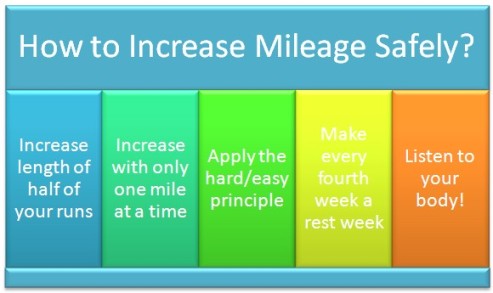
There are some rules of thumb that can be used to increase mileage. This might help you in setting up your own running training program.
These are general rules to increasing mileage safely:
Increase the Length of Half Your Runs
Do not increase the length of all your runs at once. Instead, increase the length of about half your runs.When you do four workouts per week, then increase the length of only two of your runs.
When you run three times a week, increase the length of every second run.

Increase with Only One Mile at a Time
Be cautious with adding too many miles to one workout at once. You can make fantastic progress by only adding a mile at a time.Many runners try to jump from 3-mile runs straight to 5-mile runs. That's a 67% increase in one go. Your legs aren't ready for that kind of shock. This challenge is covered in more detail in the building up running time article.
Apply the Hard/Easy Principle
Done a long run once, then next time do a shorter run. Done a hard workout, then next day do an easier one.Make your body work to make progress. But let your body recover as well!
This principle becomes even more important when you're adding mileage. Your body's already dealing with the stress of more volume. Don't pile intensity stress on top of it every single day.

Make Every Fourth Week a Rest Week
When you're building your mileage week after week after week, it's wise to consolidate your efforts every so often.A good rule of thumb is that every month, so every fourth week or so, you cut back your mileage to about 75% of what it was the previous week. This gives your body a chance to recover.
After a tough week, going back to 75% suddenly seems so easy. That way, you build up your resources again and you get ready for the next few tough weeks.
Build in the occasional consolidation week. You need that.
Rest every fourth week might not be enough for you. Notice that you're fatigued? Then try to make every third week a rest week. See what works best for you.
Listen to your body! Sorry, just wanted to say it once more.
Common Mileage Building Mistakes

Adding Miles Too Fast
You're excited. You want to get to your goal mileage yesterday. Understandable. But your tendons, ligaments, and bones adapt slower than your cardiovascular system.Your heart might feel ready for 40 miles per week after two months of training. Your Achilles tendon disagrees. And your Achilles tendon always wins that argument.
Increasing Every Single Run
This one's huge. You don't need to make every run longer to increase weekly mileage.If you're doing four runs per week at 3 miles each, you don't need to bump all four to 4 miles. Instead, keep two at 3 miles and bump two to 4 miles. Same weekly increase, half the risk.
Ignoring Warning Signs
Your knee's been a bit achy for three days. Your usual pace feels harder than normal. You're sleeping poorly.These aren't signs to push through. They're your body asking for a break. It's better to take two easy days now than be forced into two easy weeks later.
Skipping Rest Weeks
"I feel fine, I don't need a cutback week."Famous last words. Rest weeks aren't for when you feel bad. They're to prevent you feeling bad in the first place.
Every single elite runner uses planned rest weeks. Your body isn't stronger than theirs.
Example of Increasing Mileage

What could your training schedule look like for the next weeks? We assume that you keep on doing four workouts every week.
There isn't one solution to this question. Using the guidelines just given, a training plan could look as follows:
Week 1: 3 - 3 - 3 - 3. Total = 12 miles
Week 2: 3 - 4 - 3 - 4. Total = 14 miles
Increase of two miles. More than the 10% rule, but that's fine, you're only increasing your mileage on two of your four runs.
Week 3: 3 - 5 - 3 - 5. Total = 16 miles
Again an increase of two miles. Again more than the 10% rule. By the way, see the hard/easy principle starting to shape.
Week 4: 3 - 3 - 3 - 3. Total = 12 miles
Cut back to 75% of your training load. Twelve miles suddenly feels a lot lighter than three weeks ago!
Week 5: 3 - 5 - 4 - 6. Total = 18 miles
Increase one of the shorter runs so that your shorter and longer runs don't get too far apart.
Week 6: 4 - 5 - 4 - 7. Total = 20 miles
Again an increase in one of the shorter runs as well as in the longest run. Keep in mind that your longest run can be in somewhat lower intensity than the other runs. You're trying to cover distance here, not trying to get there as fast as possible.
Week 7: 4 - 6 - 4 - 8. Total = 22 miles
Steadily increasing with 2 miles per week we're already doing ten miles more than six weeks ago!
Week 8: 3 - 4 - 3 - 5. Total = 15 miles
Again a significant cut-back in the fourth week. Give those legs a fresher-upper.
Week 9: 4 - 6 - 5 - 9. Total = 24 miles
After the rest week you're fresh again and add another 2 miles to your mileage.
Week 10: 4 - 6 - 5 - 10. Total = 25 miles
And you've done it. 25 miles per week.
Adapting the Plan to Your Situation
Would you be able to increase your mileage like that example? That's really not known.Maybe you need to build up a bit slower. Maybe you need to have a rest week every third week or maybe even every second week. Maybe you can only get to 20 miles now and in a few months time you can add on extra mileage.
It all depends. On your legs, your body, your mind.
If You're Starting from Very Low Mileage
You're running 6 miles per week total? The 10% rule is definitely too conservative for you. You could probably handle 2-mile increases per week for the first few weeks. You can find helpful strategies in the distance running tips guide.Your body can adapt quickly when you're starting from such a low base. Just don't get cocky and try to jump straight to 20 miles per week.
If You're Already at High Mileage
You're doing 50+ miles per week? Now the 10% rule might actually be too aggressive. At this level, 3-5% increases per week are preferred. For advanced strategies, check out the tips for long distance running article.Your body's already handling significant stress. Small increases compound over time without overwhelming your recovery systems.
If You're Coming Back from Injury
Cut your normal progression in half. If you'd normally increase by 2 miles per week, make it 1 mile per week.Your fitness might feel ready, but your injury-prone area needs extra time to adapt. Too many runners re-injure themselves by rushing back to their old mileage too quickly.
Signs You're Increasing Too Fast
Your body will tell you when you're pushing too hard. Here's what to watch for:Physical Warning Signs
- Persistent muscle soreness that doesn't improve with easy running
- Joint pain, especially in knees, hips, or ankles
- Unusual fatigue that lingers through rest days
- Elevated resting heart rate for multiple days
- Getting sick more often than usual
Performance Warning Signs
- Your easy pace feels harder than it should
- You're struggling to hit paces that were comfortable last week
- Your legs feel heavy from the first step of every run
- You're dreading runs instead of looking forward to them
The Long Game of Mileage Building
Here's what every runner, all of us, should consider: think in seasons and years, not days and weeks.Getting from 20 to 40 miles per week doesn't need to happen in two months. Give yourself four months. Or six months. The extra time you spend building gradually is time you won't spend injured later.
After years of observing runners, you know which runners improve the most over time? Not the ones who build mileage fastest. The ones who build it most consistently.
Consistency beats intensity every single time. Effective approaches are explored in the increasing pace and distance guide.
Important Last Words

When you're currently only doing easy base running and you're adding mileage and workouts, your risk of injury exponentially increases. So remain sensible in your approach.
Adding mileage and adding speed/quality at the same time can work, but it's a higher risk strategy.
Adding mileage is a surefire way to improve your running. However, you need to realize that it increases your injury risk. So follow a deliberate, consistent, conservative approach to increasing your mileage.
In the short term it may feel like you're building up too slowly. But in the long term it'll help you stay injury-free and will make you fitter and faster.
Whatever you do, keep in mind: listen to your body!
Frequently Asked Questions
How do I know if I'm increasing mileage too quickly?
Your body will tell you through warning signs like prolonged muscle pain, severe fatigue, joint aches, or an elevated resting heart rate. If your usual pace suddenly feels much harder or you're struggling with sleep, you're probably pushing too fast. Back off for a week and let your body catch up—your tendons and bones adapt much slower than your cardiovascular system.
Should I add miles to all my runs when building weekly mileage?
No, this is one of the biggest mistakes I see runners make. Only increase the length of about half your runs each week. If you're running four times per week, just extend two of those runs and keep the others at their current distance. This approach gives you the same weekly mileage increase with significantly less injury risk.
What's a safe amount to add to individual runs when building mileage?
Stick to adding just one mile at a time to any single run. I know it seems conservative, but jumping from 3-mile runs straight to 5-mile runs is a 67% increase that your legs simply aren't ready for. One mile at a time might feel slow, but you'll make fantastic progress without the setbacks that come with being too aggressive.
How often should I take a cutback week when increasing mileage?
Plan for every fourth week to be a rest week where you drop your mileage to about 75% of the previous week. If you're feeling particularly fatigued, don't be afraid to make it every third week instead. These consolidation weeks aren't weakness—they're essential for letting your body adapt and preparing you for the next phase of building.
At what weekly mileage does the 10% rule actually work well?
The 10% rule works best for runners doing roughly 20-35 miles per week. Below that range, you're probably being too conservative and could increase faster. Above that range, 10% becomes unrealistically large jumps that most runners can't handle safely. It's a decent guideline for that middle range, but don't treat it as gospel.
Some other pages you may like
About the author

Dominique de Rooij (Dom)
Advanced Running Coach certified by Athletics Australia with 20 years of writing about running and over a decade coaching runners — from first-timers to marathoners. Dom's beginner programs have guided thousands of runners and been praised above plans from Jeff Galloway, Hal Higdon, and Runner's World. Now over 50, Dom still loves trail running, parkrun, and the coffee after.
Free weekly coaching • Join 3,500+ runners
Train Smarter, Not Just Harder
Get your free guide when you join the BRT Coaching Letter
No spam, ever. Unsubscribe in one click, any time.
What's New?
-
Personalized Running Coaching - BRT | Run Smarter, Race Better
 Get a personalized running program built around your current fitness, goals, and schedule - not a generic app template. Choose from BRT Silver, Gold, or Platinum coaching with Dom, accredited running…
 -
Sample 4-Day Marathon Training Week: Base to Taper
A full 4-day-a-week marathon training schedule, phase by phase - base, build, peak, and taper - with named workouts and weekly mileage. -
Marathon Taper for a 10-12 Week Training Cycle
How to taper correctly on a compressed 10-12 week marathon plan - the right taper length, why standard advice doesn't fit, and the week-by-week structure.
